
When a warehouse chooses dynamic storage like pushback or pallet flow, it is usually because the operation is under pressure to do more with the same footprint. Density matters. Throughput matters. Lead times matter. And unlike basic static racking, dynamic systems are less forgiving when projects get rushed, shipping gets complicated, or installation conditions change late in the game.
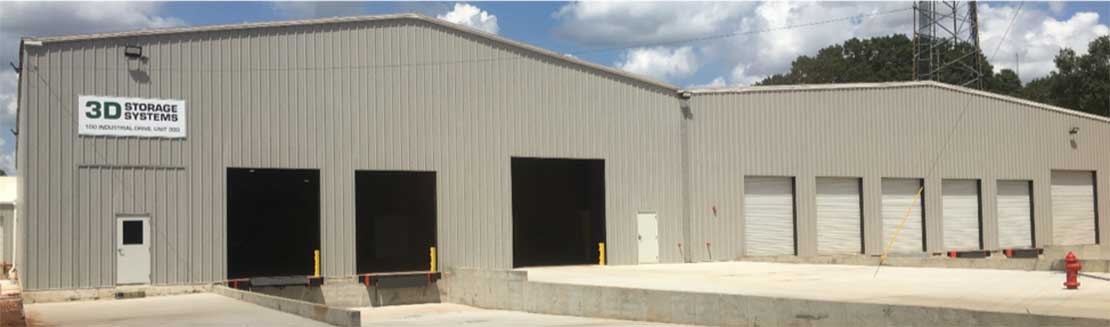
That is the context behind 3D Storage Systems’ US manufacturing base in Cartersville, Georgia.
The Cartersville facility is not a sales office, and it is not a separate product line. It is a dedicated manufacturing operation designed to support US projects with shorter transit times, simpler domestic shipping, and a true “made in the USA” foundation for dealers and end users who care about it.
Why the Cartersville plant exists
By 2019, 3D Storage Systems was growing to the point where a second facility was required to keep up with demand. At the same time, cross-border trade conditions were becoming less predictable, and leadership wanted to reduce exposure to any scenario where tariffs or border friction could impact fabricated steel products.
Adding US manufacturing capacity was both a growth move and a resilience move.
Cartersville was selected for practical reasons. The Atlanta region offers strong logistics advantages, access to a large workforce, and direct flight connectivity from most major US markets. For a manufacturing business supporting national distribution and dealer partners, that combination matters.
The facility opened in 2019 and reached a normal, fully operational state by early 2022.
What the US facility does, and what it does not do
Cartersville is a manufacturing plant. That focus is intentional.
Customer-facing sales, engineering, and design support remain centralized through the broader 3D Storage Systems organization. The result is consistency in how projects are quoted, designed, and supported, while manufacturing capacity is placed where it benefits US deliveries.
From a production standpoint, the goal is simple: the finished product coming out of the Georgia plant is built to the same standard as the Canadian facility, with comparable equipment and comparable processes. The output is meant to be identical, because the performance expectations of dynamic storage do not change depending on which side of the border a job is on.
Why a US base matters for dynamic storage projects

Dealers and end users often think about dynamic storage in terms of lane depth, SKU profiles, and performance outcomes. Those are the right questions. But there is another layer that becomes more important as projects scale: execution.
A US manufacturing base creates execution advantages that show up in several practical ways:
1) Freight savings and faster delivery windows
Shipping dynamic racking is not a minor detail. Loads are heavy, space-consuming, and time-sensitive. For many regions in the US, producing in Georgia can reduce freight costs compared to shipping from Canada.
It can also tighten delivery timelines. In some cases, shipping from Georgia can mean next-day arrival for certain destinations. That kind of responsiveness is useful when projects are sequencing installation crews, managing tight shutdown windows, or recovering from schedule changes.
2) Cleaner domestic shipping for US projects
Even when a supplier handles customs paperwork on behalf of the buyer, cross-border shipments still add complexity to scheduling and logistics. A US plant reduces that friction by keeping US deliveries domestic.
3) “American steel, American workers” for buyers who prioritise it
Many US buyers care deeply about domestic production. This has been true for decades, and it continues today. The Cartersville facility allows 3D to credibly support that preference by manufacturing with American workers and using American steel for US projects.
For certain dealers, this is not a marketing footnote. It is a meaningful part of the purchasing conversation.
The US market reality: bigger footprints, bigger projects
3D Storage Systems has long served the US market, and leadership notes that US projects tend to scale larger than Canadian ones. A customer might build a 100,000 square foot warehouse in Canada, then build an 800,000 to 1,000,000 square foot facility in the United States to support a similar operation.
That difference in scale is one of the reasons a US manufacturing base matters. Large projects increase the cost of delays, increase the stakes of shipping damage or mis-sequenced deliveries, and often compress schedules for installation. When the footprint grows, execution becomes even more important.
Built through constraints, ramped with intent
Like many industrial expansions, the Cartersville ramp-up was not a straight line.
The plant was set up during a period when travel and on-site support were constrained. Early operations required workarounds and staged capability build-out. Over time, processes normalised and the facility reached full operational maturity in early 2022.
That timeline is part of the story because it reflects something dealers care about: the plant is not a concept or a pilot. It is an established manufacturing base with years of production behind it.
What having two plants makes possible
A two-plant footprint gives 3D Storage Systems more options to protect delivery commitments.
In the past, it also created flexibility to balance production across facilities when one plant was busier than the other. While cross-border conditions may influence how that flexibility is used at any given moment, the strategic advantage remains the same: capacity in more than one location helps 3D respond to demand, schedule shifts, and delivery requirements with more agility.
Looking forward: growth pressure is a good problem
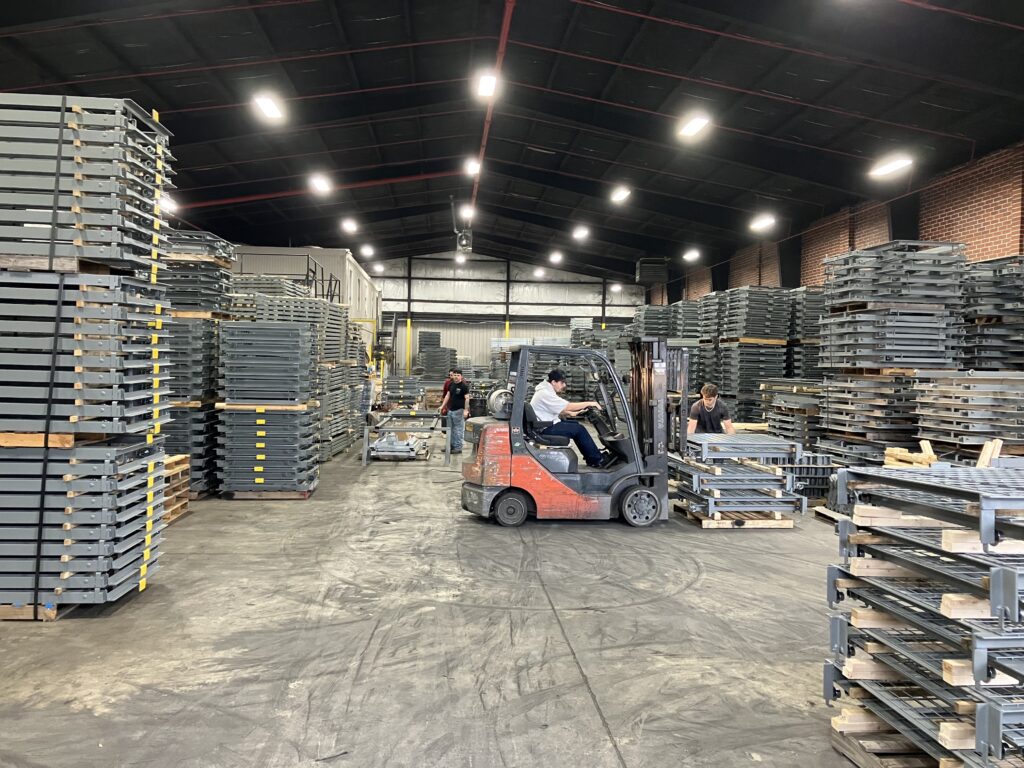
The Cartersville facility is now operating in a context of continued demand, and leadership is already looking ahead to what the next 5 to 10 years could require in terms of expansion, both in the US and Canada.
That forward planning is not about change for the sake of change. It is a response to growth, and growth is a sign that dealers and end users continue to invest in higher-density storage as warehouses scale, footprints tighten, and operations demand more performance from every square foot.
The practical takeaway for dealers
For dealers and rack manufacturers, the Cartersville story can be summarised simply:
3D Storage Systems has US-based manufacturing capacity dedicated to dynamic storage, designed to support US projects with faster delivery potential, reduced freight complexity, and a made-in-USA production story, without changing the product standard or how projects are engineered and supported.
For any dealer looking to win dynamic storage projects in a market where speed, confidence, and execution matter, that is a meaningful advantage.
For more information or to connect with someone at 3D, we invite you to contact us; we’d love to hear about your project!