
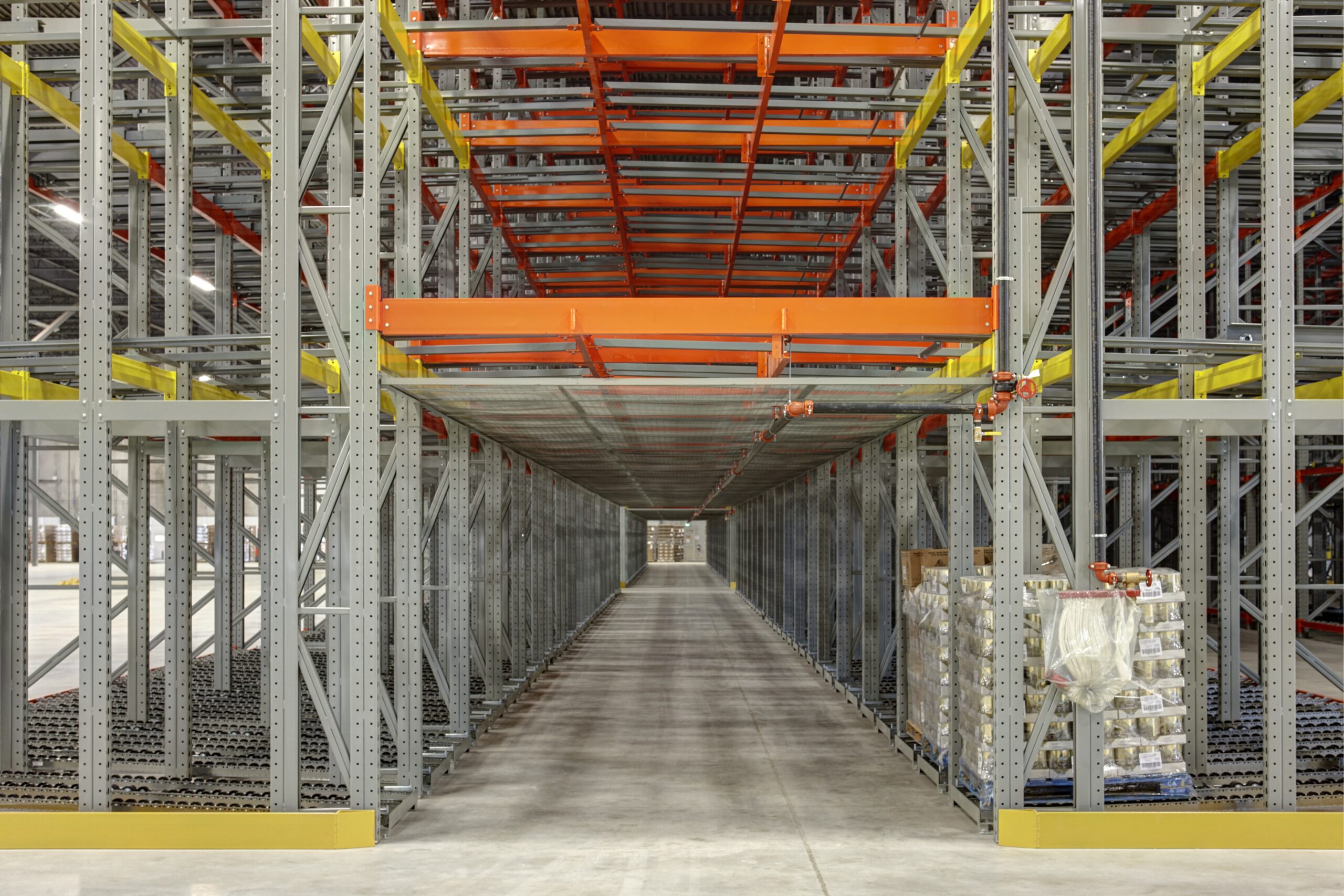
The problem with picking a system before you understand the inventory
For decades, the storage industry has worked from a few simplifying generalizations. Pallet flow equals FIFO. Pushback equals LIFO. More density is better. Deeper lanes store more pallets.
As a manufacturer of both pallet flow and pushback systems, and as an organization that spends much of its time configuring rack layouts with dealers and end-users, we’ve found that those generalizations hold true in some applications, but the picture is often subject to change once real inventory data is reviewed.
The right storage solution is determined less by the product label on the rack and more by the fit between inventory profile, pallet characteristics, operating rules, and the performance expected from the system. And the single most important input in that fit is the relationship between the average number of pallets per SKU and the lane depth being considered.
This article walks through how we think about that relationship, the framework we apply to it, and a worked example using the same logic we’d bring into a layout discussion with a dealer or end-user.
The framework: occupancy, the Rule of 3, and honeycombing
When we ask an end-user for inventory information, the data points we look for are the number of products (SKUs), the number of pallets per product, and the typical incoming and outgoing quantities, whether that’s one pallet at a time, a truckload at a time, or something in between.
Those numbers matter because storage systems aren’t measured by their theoretical pallet count. They’re measured by occupancy, which we define as the actual number of pallets stored divided by the theoretical maximum, expressed as a percentage. A system with a capacity of 100 pallets that’s currently storing 75 is running at 75% occupancy.
That distinction is important because inventory fluctuates by nature. If a SKU averages 10 pallets, it sometimes has more and sometimes less. In a deep-lane system, that fluctuation forces a second lane open, and occupancy drops. This is what causes honeycombing, which is the reason theoretical capacity rarely matches what a warehouse actually achieves.
To counter it, we apply what we’ve called the Rule of 3 for the last 35 years or so: any deep-lane storage system should hold an average of at least three times the lane depth in pallets per SKU to maintain 75% occupancy or higher, which we treat as the minimum acceptable utilization for any storage solution. A 10-deep flowrack needs 30 pallets per SKU to clear that bar. A 15-deep flowrack needs 45. A 4-deep pushback lane needs 12.
The Rule of 3 is a quick feasibility check. If a customer’s inventory doesn’t meet it for a given depth, occupancy will typically fall below the 75% threshold we treat as a healthy minimum.
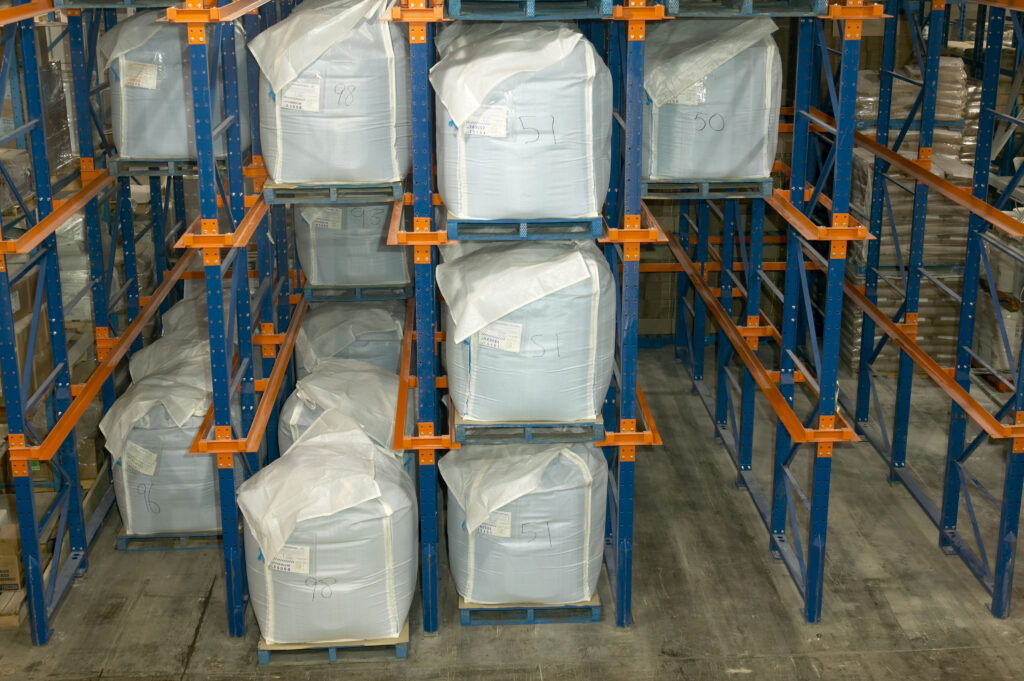
Worked example: how occupancy moves with inventory in a 10-deep flowrack
Take a 10-deep flowrack with a single SKU averaging 10 pallets. With one full lane, occupancy is 100%. As soon as inventory climbs to 13 pallets, a second lane opens to hold the extra three, and occupancy drops to 13 of 20, or 65%. Over time, with stock moving in and out, the system will more typically look like one part lane of incoming product and one part lane of outgoing product, putting occupancy at roughly 50%. Operating any storage system at 50% occupancy is very expensive.
To get back to a healthy utilization level, the SKU has to carry more pallets. Twenty pallets across three lanes gets you to 66%. Thirty pallets across four lanes, with two full lanes and two part lanes for incoming and outgoing stock, gets you to 75%. That’s the Rule of 3 in action: depth of 10, multiplied by 3, equals the 30 pallets per SKU needed to make a 10-deep system perform.
The same Rule of 3 applies when we look at pushback, paired with one additional rule: never replenish a partially filled lane with a new lot code of the same product or with a different product. In a 4-deep pushback lane, the Rule of 3 means we should only put SKUs averaging 12 or more pallets into the system. With 12 pallets distributed across four lanes (one part lane outgoing, one part lane incoming, two full lanes), we hold 75% occupancy. To preserve rotation, including FIFO, the operator picks from the oldest part lane first and follows the replenishment rule above when new lot codes come in.
Matching pallets per SKU to lane depth
Pulling this together, here’s how 3D’s published rule of thumb for a 4-pallet-high scenario maps inventory to system type and lane depth.
| Average pallets per SKU | Selective rack | Drive-in rack | Pushback rack | Pallet flow rack |
| 1 to 5 | Single deep | N/A | N/A | N/A |
| 6 to 8 | Double deep | N/A | 2 deep | N/A |
| 9 to 11 | N/A | N/A | 2 or 3 deep | N/A |
| 12 to 14 | N/A | N/A | 3 deep | N/A |
| 15 to 23 | N/A | N/A | 3 or 4 deep | N/A |
| 24 to 35 | N/A | 2 deep | 4 or 5 deep | 8 deep |
| 36 to 47 | N/A | 3 deep | 4, 5, or 6 deep | 12 deep |
| 48 to 59 | N/A | 4 deep | 5 or 6 deep | 16 deep |
| 60 to 71 | N/A | 5 deep | 5 or 6 deep | 20 deep |
| 72 to 83 | N/A | 6 deep | 6 deep | 24 deep |
For 1 to 5 pallets per SKU, single deep selective rack is the recommended fit. None of the deep-lane systems are recommended in this range. For 6 to 8 pallets per SKU, the options are double deep selective or 2-deep pushback. For 9 to 11 pallets per SKU, 2- or 3-deep pushback. For 12 to 14, 3-deep pushback. For 12 to 23, 3- or 4-deep pushback. At 24 to 35 pallets per SKU, drive-in becomes feasible at 2-deep, pushback moves to 4- or 5-deep, and 8-deep pallet flow enters the picture. From 36 to 47 pallets per SKU, drive-in goes to 3-deep, pushback to 4-, 5-, or 6-deep, and pallet flow to 12-deep. At 48 to 59, drive-in is 4-deep, pushback is 5- or 6-deep, and pallet flow is 16-deep. From 60 to 71, drive-in is 5-deep, pushback is 5- or 6-deep, and pallet flow is 20-deep. At 72 to 83 pallets per SKU, drive-in and pushback are both 6-deep and pallet flow is 24-deep.
A few things stand out about that table that are worth saying plainly.
Pushback becomes easy to justify once a SKU averages more than five pallets. The higher the number of pallets per SKU, the deeper the lane depth becomes feasible, with a typical minimum of three lanes per product so that rotation, including FIFO, is achievable. Pushback systems can be configured to attain up to 100% more pallets stored than standard pallet racking, and equal or greater increases over poorly occupied drive-in or floor storage layouts.
Pallet flow doesn’t appear in the recommendation set until you get to 24 or more pallets per SKU. Because deeper lanes require proportionally more pallets per SKU to maintain occupancy under the Rule of 3, the inventory threshold for flow systems is naturally higher. The most successful flowrack applications involve high volumes of similar product, typically a manufacturer of consumer products with a limited number of SKUs, generally under 100, specifically to avoid honeycombing.
Standard selective rack remains the best fit for high-SKU, low-pallets-per-SKU profiles, where its highest average occupancy and good height utilization are the strongest assets.
Why most warehouses need more than one storage method
The key conclusion from the table, and from years of laying out real systems, is that no one storage type is suitable for every category of inventory. We generally like to see at least two, if not three or more, storage methods in any given warehouse. A typical distribution center follows the 80/20 pattern, where 20% of SKUs represent 80% of the volume. Those high-volume SKUs are usually the candidates for deeper-lane dynamic storage. The long tail of lower-volume SKUs typically belongs in selective rack, where occupancy stays high.
Apply the Rule of 3 by SKU class. Match the depth to the pallets per SKU, not to the building. The result is the best combination of FIFO, selectivity, storage density, and lowest overall cost.
The inputs that actually drive the answer
When a dealer or end-user asks us what system fits a given application, the honest answer always starts with the same questions. How many SKUs? How many pallets per SKU on average? What are the typical incoming and outgoing quantities? What are the rotation requirements?
Once those numbers are on the table, the framework does most of the work. Apply the Rule of 3. Check the pallets-per-SKU range against the rule-of-thumb table. Account for the specifics of the application, the pallet, the environment, and the rotation discipline the operator can realistically maintain. That sequence consistently produces a layout that performs in practice, not just on the spec sheet.
Theoretical density tells you what a system could hold. Occupancy tells you what it actually holds once real inventory moves through it. The Rule of 3, applied honestly to pallets-per-SKU data, is how we keep the two aligned.