
Why Many Operations Are Moving Away from Drive-In Racking
Summary for Dealers
- Inventory trends and safety priorities have shifted the industry toward pushback.
- Drive-in still has a place, but only for high-volume, low-SKU environments.
- Dealers can guide customers effectively by focusing on SKU depth, operational efficiency, and total cost of ownership.
For more than twenty years, warehouse operators have been re-evaluating drive-in racking as inventory patterns shift and safety expectations rise. While drive-in was once the logical choice for high-volume, low-SKU storage, modern operations increasingly favour pushback systems for their flexibility, occupancy, and efficiency.
This overview gives dealers clear reasoning, supported by direct insights from 3D Storage Systems CEO Kevin Minkhorst, to help guide client conversations.
Lot Quantities Are Shrinking… and It Matters
Drive-in racking only performs well when pallet quantities per SKU are high enough to fill deep tunnels.
Kevin Minkhorst explains the practical challenge clearly: “A drive-in system requires larger lot quantities in order to get good density and utilization… if you’re four pallets high and five pallets deep, that’s 20 pallets in that tunnel, and then you’ve got to have at least three tunnels… you’re talking 60 pallets per product in order to make good use of that drive-in.”
Many warehouses now deal with smaller lot sizes and higher SKU variety than in the past, which makes it harder to maintain the large pallet counts needed for drive-in to operate efficiently.
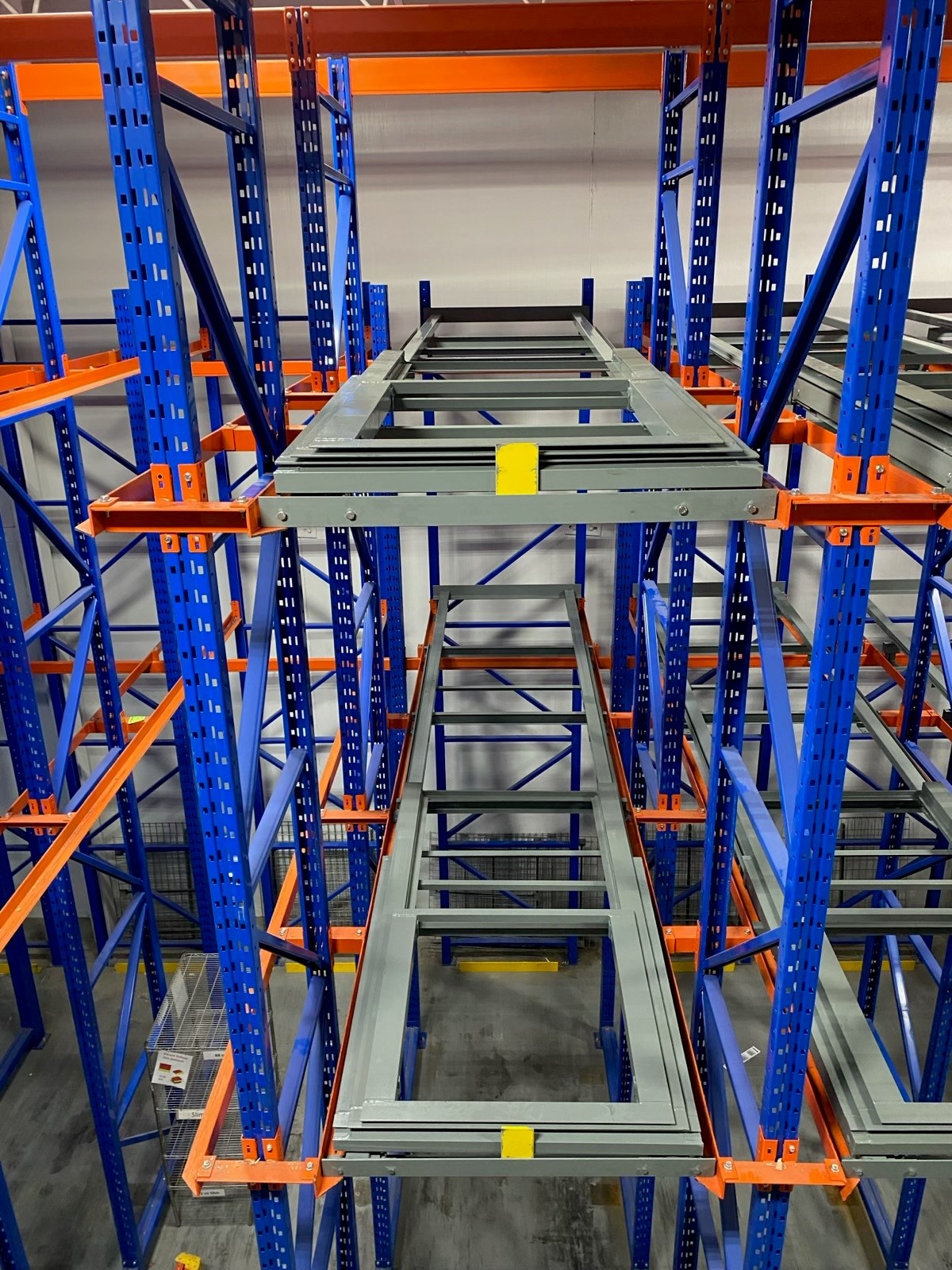
A five-deep pushback lane reaches full density with just 15 pallets per product, making it better aligned with current SKU and inventory patterns.
3D’s Justification Handbook includes SKU-per-depth tables that illustrate this logic in detail.
Lost Storage Space from Honeycombing
Honeycombing — empty, unusable space left in a deep lane — becomes a bigger issue when SKUs increase and pallet counts decrease.
While honeycombing can occur in any deep-lane system, it is more severe in drive-in because tunnels require large quantities to maintain occupancy.
When customers try to work around this by mixing products in a drive-in lane, the hidden labour cost becomes significant. Minkhorst notes: “Sometimes people realize that they have honeycombing going on and so to solve it, they mix product in the tunnels… but then they realize they’re getting killed in manpower by constantly having to move pallets around.”
Pushback avoids tunnel-entry handling and reduces the need to shuffle inventory.
Pallet Quality and Rack Damage Are More Critical in Drive-In
Structural vulnerability
Drive-in systems place the forklift directly inside the rack structure, which naturally increases the chance of frame contact. Over time, even small, repeated bumps create cumulative wear. Kevin Minkhorst notes that damage is a recurring issue in drive-in systems, especially as they age. He explains that most existing drive-in installations he sees have accumulated damage over time and that this is a common reason customers move away from the system.
The design of drive-in contributes to this vulnerability. The frames are tall, with the columns tied together primarily at the top, leaving a long, unsupported span that is more susceptible to sway and lateral force. Because operators must navigate narrow tunnels with a raised load, the margin for error is small.
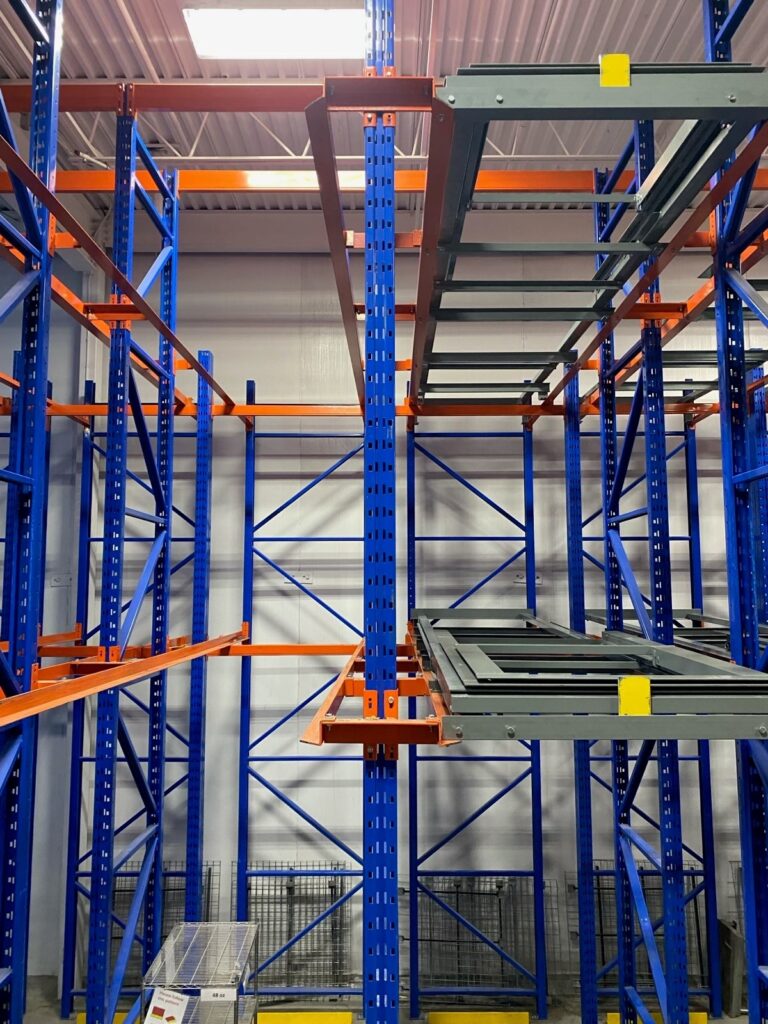
In contrast, pushback racking distributes structural ties across multiple beam levels throughout the bay, creating a more rigid system that better resists impact. Dealers should be aware that this structural difference is one of the main reasons customers often move away from drive-in.
“…the industry has shifted from strong hardwood pallets to more economical softwood options, which increases the likelihood of cracked boards, inconsistent dimensions, or weakened contact points.”
Pallet dependency
Drive-in is also more sensitive to pallet condition. Since the system supports each pallet only along its two outer edges, the entire load depends on the integrity of those perimeter boards.
In addition, as Minkhorst notes, the industry has shifted from strong hardwood pallets to more economical softwood options, which increases the likelihood of cracked boards, inconsistent dimensions, or weakened contact points.
When the pallet’s underside fails in a drive-in system, there is little redundancy built into the structure to prevent the load from dropping. Pushback racking avoids this limitation by using full-width, heavy-duty carts that support more of the pallet surface. This design accommodates pallet variability far more effectively and reduces the operational risk associated with aging or inconsistent pallet pools.
For many customers, this difference becomes a deciding factor.
Engineering Standards Have Narrowed the Cost Gap
Drive-in racking has long been viewed as the lower-cost high-density option, but modern engineering and seismic requirements have changed that calculation. Current standards place stricter demands on how racking systems must handle lateral forces and overall structural stability. Because drive-in relies on upright frames that span the full height with fewer intermediate connection points, bringing these systems up to code often requires thicker steel, additional bracing, and heavier components than earlier installations would have needed.
Pushback racking, by design, includes multiple beam levels throughout the structure. That built-in rigidity means fewer adjustments or reinforcements are typically required to meet the same engineering criteria. As a result, the initial cost difference between the two systems has narrowed considerably, and in some configurations, they can be comparable.
3D’s layout studies reinforce this from a space-planning perspective. Pushback often fits more pallet positions into the same building footprint, or delivers the same number of pallet positions in less square footage. When customers evaluate the full picture — rack cost, floor space, building size, and long-term operational efficiency — the total cost per pallet stored often tilts toward pushback rather than drive-in. For dealers, this is a practical point to communicate: decisions based solely on historical assumptions about price may overlook the more relevant cost factors in today’s environment.
When Drive-In Still Makes Sense
Drive-in remains appropriate for specific high-volume applications, including:
- Low SKU count
- Very high pallet quantities per SKU
- At least 3 tunnels per product
- Uniform pallet quality
- Lower frequency of SKU turnover
Examples include beverage production, water bottling, and commodity goods with large production runs.
“It is possible to get a good use of a drive-in if you have the right inventory.” Minkhorst asserts.
What Dealers Should Communicate to Customers
Dealers should focus on helping customers match the storage system to their SKU behaviour, since drive-in remains best suited for large, uniform lots while pushback is more effective for mixed SKUs and moderate lane depths.
It is also important to frame the discussion around total cost of ownership rather than rack price alone, drawing attention to ongoing considerations such as damage, labour, and occupancy. Dealers can strengthen these conversations by highlighting 3D’s engineering-first approach, including linked carts, dependable empty-cart return made possible by the 3/8 inch per foot slope, the high structural rigidity of the rack design, and the availability of detailed SKU and inventory analysis supported by custom CAD layouts.
Finally, as customers plan for growth, dealers can position pushback as a future-ready option that adapts more easily to rising SKU counts without requiring extensive warehouse reconfiguration.