
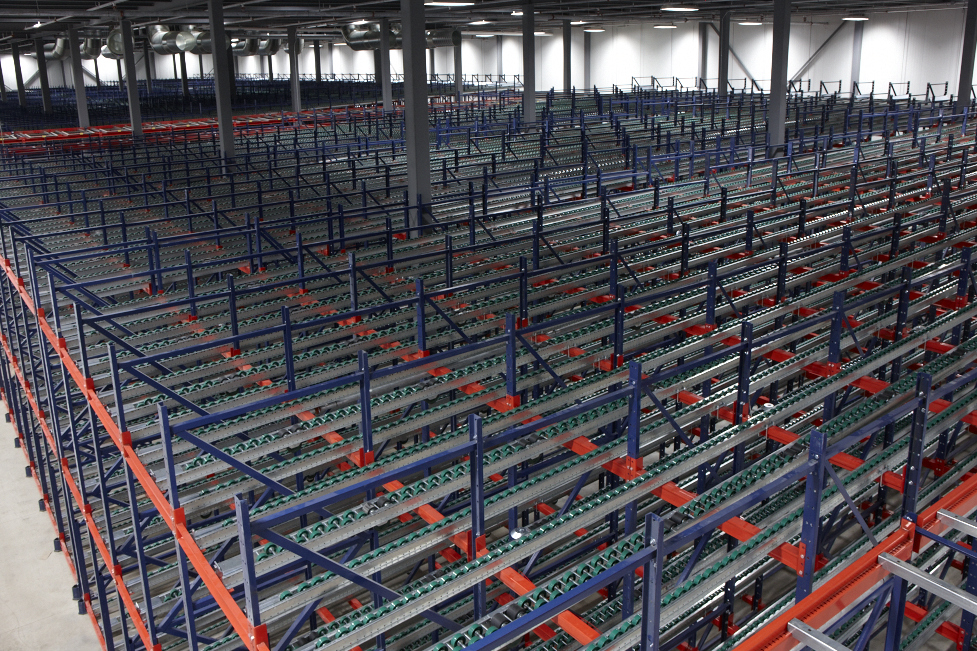
When you are developing a storage spec for a cold storage client, every design decision carries more weight than it would in a dry warehouse. Refrigerated and freezer space costs roughly twice as much per square foot to build as ambient space. That single fact changes the math on everything downstream, because the storage method you choose stops being a simple capacity question and becomes the biggest lever on the return the facility will deliver.
Cold storage racking systems are not a separate product category so much as the same engineered dynamic storage, applied with sharper discipline. The systems themselves handle the cold. 3D pallet flow installations operate from 122°F down to -40°F, including blast freezers. What changes in the cold is how much a good design is worth, and how little room there is for an inefficient one.
Why density matters more in the cold
Start with the number that drives the whole conversation. A freezer warehouse runs on the order of $200-300 per square foot to build, against roughly $100-150 for a standard ambient facility. Every square foot you save in a freezer is therefore worth about double what it would be worth in a dry building.
High density dynamic storage is how you save those square feet. Pallet Flow and Pushback racking can be configured to store up to 100% more pallets than standard selective rack, with similar or greater gains over poorly occupied drive-in or floor storage. In one of 3D’s own layout comparisons, about 2,930 pallet positions that would take 31,000 square feet of selective rack fit into 16,300 square feet of five and six deep pushback. That is roughly half the footprint for the same number of pallets. In an ambient building, that saving is attractive. In a freezer, at double the cost per square foot, it’s a critical part of the build discussion.
This is why the real cost conversation is never just the price of the rack. The true cost per pallet stored includes the building, the land, the forklifts, labor, product damage, and maintenance. In cold storage the building and energy share of that total is large enough that footprint efficiency dominates, and footprint efficiency is exactly what dynamic storage buys.
A real freezer conversion: Mars Pet Care
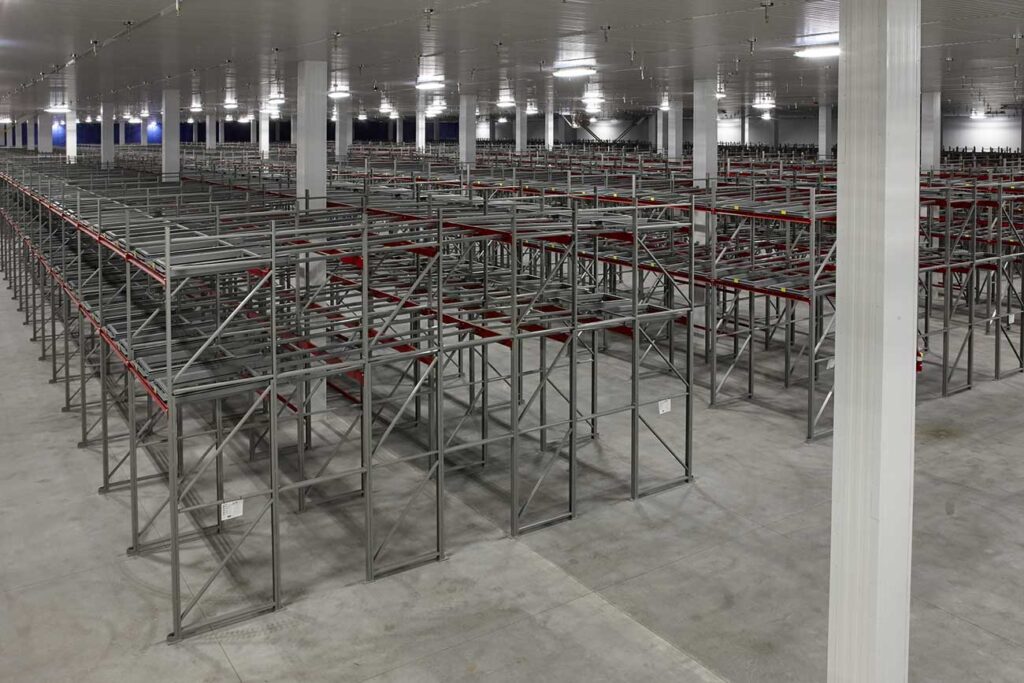
The case for density in the cold is easier to see in a finished project. When Mars Pet Care needed freezer capacity for large batch purchases of meat product, they bought a vacant building and converted it from an ambient warehouse into a freezer. The plan had to maximize storage while keeping enough selectivity to rotate product on a first in, first out basis.
The result was just over 18,000 pallet positions of two, three and four deep pushback inside 154,000 square feet of freezer. Pushback was chosen over double-stacked floor storage specifically because it delivered that density without paying for carts, rails and beams on the bottom level, and it produced triple the pick faces of drive-in rack while preserving FIFO rotation. The project came in on time and on budget. It is a clean illustration of the principle: in a freezer, the storage method is a capital and operating decision, not a hardware line item.
Match the system to the inventory, not the square footage
A solid design works from the inventory first. The inputs that determine the right system are:
- Number of SKUs and average pallets per SKU
- Incoming and outgoing quantities, and turnover
- Pallet type, weight, load stability, and bottom board condition
- Operating temperature and environment
- Lift truck type and operating method
- Selectivity and rotation requirements
- Likely future changes to the operation
From those inputs, a few rules of thumb do most of the early work. 3D has long used the “Rule of 3”: a deep lane system is feasible when average pallets per SKU are about three times the lane depth, which keeps occupancy at or above 75%. A ten-deep lane, for example, wants roughly 30 pallets per product to stay well occupied. Pushback becomes easy to justify once pallets per SKU climb past five, and deeper lanes make sense as that number rises: two and three deep for six to nine pallets per SKU, three and four deep into the teens, and four, five and six deep beyond twenty.
One more principle carries over directly from 3D’s design practice: the lowest cost storage is the one that matches the storage type to the inventory, and an inventory analysis usually shows that three or four storage types are needed rather than one. Cold facilities tend to hold a varied set of SKUs with different pallet counts, rotation needs, and throughput, and a layout that accommodates more than one high-density method is what covers that full range.
The product sets, applied to cold storage
Pushback is the density workhorse for medium to high pallets per SKU and high turnover. It has been installed six deep in freezers running on reach trucks, and the push force required is modest, on the order of 4% of the load being pushed, which sits well within a standard lift truck’s capability. Because 3D’s wheel rolls on a low friction tube rather than a rough channel, slopes can be kept gentle, which matters when you are controlling heavy freezer loads.
Pallet flow is the automatic rotation layer. It reduces handling and product damage, carries loads from 122°F to -40°F including blast freezers, and works with counterbalance, reach, deep reach, swing reach and even clamp trucks, so it rarely forces a change in fleet. It is the natural choice for deep lane FIFO reserve in food and beverage cold storage.
Carton flow is the pick layer. Wheel track carton flow uses gravity to bring cases from the load side to the pick face, saving up to 30% of picking space while shortening pick routes and reducing picking errors. In a cold distribution center, this is the piece and case picking front end that sits in front of the reserve. 3D’s own materials document this kind of combination in a single installation, with flowrack on the first level, carton flow on the second, and pushback above.
The design discipline the cold demands
Here is where cold storage earns its own conversation. The design process is not fundamentally different, but several choices that are forgiving in a dry building become decisive in a freezer.
Component selection by temperature. The systems are proven to -40°F, but individual components carry their own temperature ratings. A sound cold storage design confirms that every part in the lane is rated for the environment rather than assuming it, and specifies appropriate materials where needed. Galvanized steel side channels are standard, and non-corrosive stainless options are available for the rollers when an application calls for them.
Wheel and roller choice. For most pallets, full width rollers present the most economical way to support pallets in a gravity flow system. These systems will also suit oddball pallets such as plastic and plastic pod as well as metal bins. 3D also uses polycarbonate wheels for deep lane flow are a polycarbonate and polyester blend, the same base material as bullet-resistant glass, which suits wide temperature ranges and resists impact. Determining the best solution and configuration may require testing the client’s actual pallets to settle this rather than guessing.
Pallet quality. Deep lane pallet flow is designed around GMA or CHEP pallets in the 500 to 2,500 pound range, and bottom board condition also drives the roller versus wheel decision. Inconsistent or damaged pallets are a bigger problem in a deep freezer lane, where a jammed load is harder to reach, so pallet consistency is part of the design brief, not an afterthought.
Speed and safety in deep lanes. Once a lane is three or more pallets deep, speed controllers keep a pallet from accelerating and spilling its load into the aisle, and 3D designs these systems to a Class A performance standard. Structural steel ramp stops bring loads to a controlled stop with a vertical safety stop at the end.
Designing the cold facility as a system
The strongest cold storage racking systems are rarely one method stretched across a building. They are a deliberate mix: a carton flow pick line in front, pallet flow and pushback carrying the reserve density, and selective rack for the low volume SKUs that do not justify a lane. The right blend comes out of the inventory analysis, the pallet data and a CAD layout built around the specific product, environment and throughput.
That is the work 3D does before any rack is quoted. For a dealer scoping a cold storage opportunity, the fastest path to a defensible design is to bring the client’s inventory profile and pallet details to the table early, so the system can be engineered to the application rather than fitted to a footprint. In a building where every square foot costs double, that is where the return is realized.