
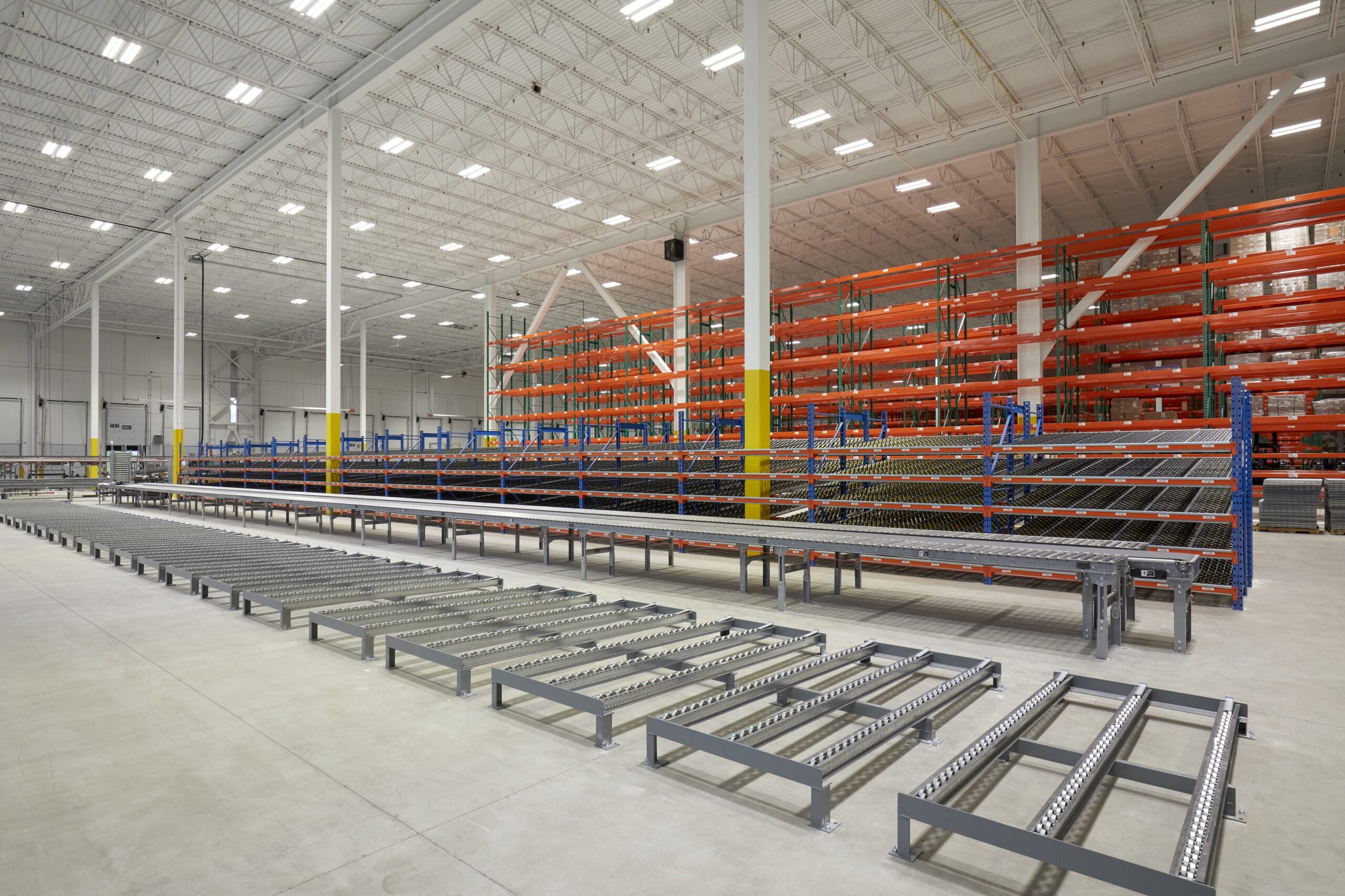
Why the strongest warehouse spec is rarely a single system, and how reading inventory behaviour leads to a better layout.
The “we’re out of space” problem that isn’t a space problem
Most dealers have heard a version of this call. A customer is convinced they are out of room and wants to talk about adding a building or cramming in the densest rack available. You walk the floor and the picture is mixed. Some zones are jammed, while others have lanes sitting half empty even though the system is technically “full.”
That gap between what a system can hold on paper and what it actually holds day to day has a name: occupancy. When a deep system is loaded with inventory that does not have the volume to fill it, partial lanes pile up and usable positions disappear into honeycombing. The building looks busy and feels tight, but a real share of the cubic space is doing nothing.
The root cause is usually not square footage. It is that the building was spec’d as though every product behaves the same way.
Inventory is not uniform, so a uniform system fights itself
No two products move through a warehouse identically. Some SKUs arrive and ship by the truckload. Others turn slowly and never exceed a handful of pallets. The familiar pattern holds in most facilities: a small portion of the SKUs accounts for most of the volume, while the long tail is made up of many products with only a few pallets each.
That spread is exactly why a single storage method struggles to serve a whole building. A system tuned for high pallet counts per SKU will strand the slow, low quantity items in oversized lanes. A system tuned for selectivity will hold the fast, high volume movers in far more floor space than they need. Either way, the building pays for the mismatch.
The pressures most operations are under today only sharpen this. SKU counts keep climbing relative to the number of pallets on hand. There is steady pressure to carry less total inventory even as sales grow. Packaging continues to get lighter, which limits safe stack heights. None of these trends reward a one size fits all layout.
The real cost lives beyond the rack price
When a layout gets evaluated on rack cost alone, the comparison is incomplete. The true cost of storing a pallet pulls in the building itself, the handling equipment, and the ongoing operating costs: labour, product damage, maintenance, and the rest. A system that looks cheap per position can become expensive once it forces a bigger building, lowers occupancy, or slows handling.
This is where the “one rack type everywhere” instinct quietly works against the customer. Maximizing density in every aisle is not the same as minimizing cost, and neither is maximizing selectivity.
What the comparison actually shows
3D’s own analysis makes this concrete. Take one inventory profile and lay it out four different ways:
– All standard selective rack.
– All pushback, keeping the building the same size.
– All pushback, with the building resized to hold the same number of pallets.
– A mix of selective rack, pushback, and floor storage, with the building sized to the inventory.
The results are worth sitting with. Filling the existing building entirely with pushback turned out to be the most expensive option of the four, not the least. Going all in on a single high density system without rethinking the building added cost rather than removing it.
The mixed layout came out lowest on total cost. It held roughly the same number of pallet positions as the all selective design while occupying well under two thirds of the floor space, because each type of inventory was placed in the system that suited it. The density went where density paid off, and the access went where access mattered.
That is the heart of the case. The win did not come from one clever system. It came from matching several systems to the way the inventory behaves.
Spec’ing the operation, not the rack
For a dealer, the practical shift is to stop asking “which rack does this customer want” and start reading the building as a set of zones, each with its own inventory personality. The fast high volume movers, the deep lots, the slow long tail, and the case picking all want different answers. An inventory analysis that captures the number of SKUs, the average pallets per SKU, and the typical in and out quantities is what turns that read into a layout.
Rotation discipline follows the same logic. The ability to run first in first out is not handed to you by a product label. It comes from how the system is configured and operated: enough lanes per product to keep stock moving, picking from the oldest partial lane first, and using random storage to keep occupancy high. Handled this way, a mixed layout does not force a trade between rotation, selectivity, density, and cost. It is how you arrive at a workable balance of all four at once.
Designing for Performance
The right storage solution is determined less by the product label on the rack and more by the fit between inventory profile, pallet characteristics, operating rules, and the performance expected from the system. Most warehouses are not one problem with one answer. They are several problems sharing a roof, and the strongest spec reflects that.
For dealers, that is also the more defensible position to bring to a customer. A layout built around how the inventory actually moves holds up to scrutiny in a way that “our densest system, everywhere” never quite does.