
When warehouse teams compare storage options, the conversation often starts with a familiar question: what is the cost per pallet?
It is a fair question, but it is also one of the easiest ways to misjudge the value of a storage system.
Too often, cost per pallet is treated like a simple equipment calculation. Rack price is divided by the number of pallet positions on the drawing, and the result is used to compare one system against another. The problem is that this approach leaves out the bigger picture. It ignores the cost of the building, the effect of occupancy, the fit between storage method and inventory profile, and the operating realities that influence whether a layout performs well over time.
The better question is not just what the rack costs. It is what the warehouse is truly paying for every usable pallet position it can store and access in the real world. That is a much more useful way to think about pushback racking ROI, and it is why cost per pallet should be viewed as a warehouse planning metric, not just a purchasing metric.
True cost per pallet means more than equipment cost
A meaningful cost-per-pallet calculation should account for more than the steel in the racking system. 3D’s own justification materials frame the issue more broadly, identifying both capital and operating costs as part of the real storage equation. That includes the cost of land, the building itself, forklifts or other handling equipment, labour, maintenance, insurance, taxes, transportation, and even product damage.
This matters because two layouts can look very different once the building is factored into the analysis.
A system with a lower upfront rack cost may still produce a higher true cost per pallet if it requires more floor space, creates lower occupancy, or pushes the operation toward future expansion sooner than necessary. By contrast, a denser system with a higher initial equipment investment may produce a much stronger return if it allows more pallets to be stored in the same footprint, or the same number of pallets to be stored in a smaller building.
That is the foundation for evaluating pushback properly.
ROI starts with inventory fit
Pushback should never be sold as a universal answer. Its ROI depends on whether it is matched to the inventory profile.
This is one of the reasons 3D puts so much emphasis on SKU depth. As a rule of thumb, pushback becomes easier to justify when the average number of pallets per SKU exceeds five. From there, the recommended depth of the system depends on the quantity of pallets associated with each product. In 3D’s guidance, 6 to 9 pallets per SKU often supports 2 and 3 deep pushback. A range of 10 to 19 pallets per SKU supports 3 and 4 deep configurations. When the quantity rises above 20 pallets per SKU, 4, 5, and 6 deep systems become more realistic options.
This is an important point for dealers and consultants because it changes the nature of the conversation. The right question is not, “How many pallet positions can this system create on paper?” The better question is, “Does this inventory actually support the lane depths needed to make those positions productive?”
If the product profile does not support the system, the apparent ROI can erode quickly.
Occupancy is one of the biggest drivers of real ROI
A storage system can look dense on a drawing and still perform poorly if occupancy drops in live operation.
This is where pushback ROI becomes more nuanced. Density by itself is not enough. Utilization matters. If lanes are frequently underfilled, the effective cost per usable pallet rises because the operation is paying for space and structure that is not being fully used.
3D addresses this directly in its FIFO and occupancy materials. One of the key reminders is that operating any storage system at 50 percent occupancy is expensive. In practical terms, if half the positions are unavailable due to inventory pattern, product mix, or poor storage matching, the theoretical cost per pallet is no longer the real cost per pallet.
That is also why 3D refers to the Rule of 3 in relation to utilization. To maintain acceptable system performance, the quantity of pallets per product should meaningfully support the storage depth, with a minimum utilization target around 75 percent. This helps prevent honeycombing and keeps the economics of the system aligned with the original design intent.
For ROI purposes, this matters enormously. A shallower system with stronger occupancy can outperform a deeper system that looks better on paper but is regularly underused.
Pushback ROI can show up in more than one way
One of the most useful aspects of 3D’s justification material is that it does not treat ROI as a one-dimensional calculation. Pushback can create value in different ways depending on the operation’s goals.
In one scenario, the goal is to increase pallet positions within the existing building. In another, the goal is to maintain a similar pallet count while reducing the footprint required. In still another, the right answer may be a mix of storage types rather than a full pushback layout. 3D’s own examples show all three possibilities.
That distinction is important because “cost per pallet” is not always about maximizing the number of positions in the same space. Sometimes it is about protecting capital by delaying a building expansion. Sometimes it is about improving cube utilization in a higher-cost facility. Sometimes it is about combining selective rack, pushback, and other methods to suit actual inventory behaviour more efficiently.
For that reason, the best pushback ROI discussion is usually not “pushback versus everything else.” It is “what storage mix produces the lowest true cost per pallet for this inventory and this building?”
What the numbers can look like
3D’s justification materials include examples that help illustrate how dramatically the economics can shift when pushback is evaluated at the system level.
In one example, a conventional selective rack layout stores 2,928 pallets in a 31,000 square foot building. In another, a pushback solution using 5 and 6 deep lanes stores 5,588 pallets in that same 31,000 square feet. In a third example, a pushback system stores roughly 2,932 pallets in only 16,300 square feet. A fourth example shows a mixed solution with selective rack, pushback, and floor storage delivering approximately 2,944 pallets in 18,900 square feet.
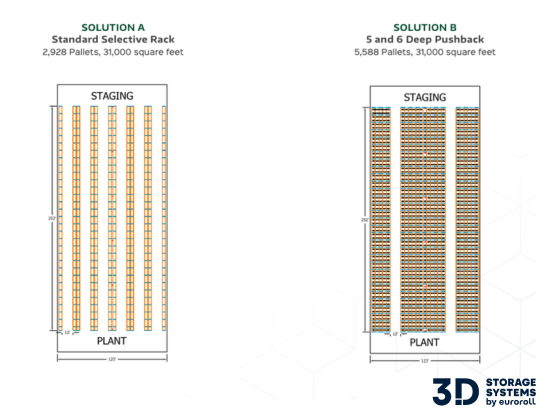
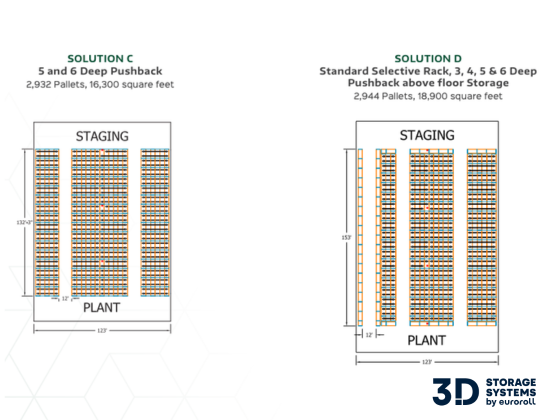
Those examples reinforce a valuable lesson.
Pushback ROI may come from storing more pallets in the same building. It may come from storing the same number of pallets in much less space. Or it may come from using pushback selectively within a broader best-fit layout that lowers the overall cost of storage.
In all cases, the value comes from system-level design, not just product-level pricing.
Why this matters even more in high-cost environments
The economics become even more compelling when the building itself is expensive to construct, operate, or maintain.
That is one reason dynamic storage often becomes more attractive in refrigerated or freezer environments. When every cubic foot of conditioned space carries additional cost, improved density can have an outsized effect on the real cost per pallet stored. The same logic applies in locations where expansion is difficult, land is limited, or the business wants to stay in its current building longer.
In those settings, evaluating pushback only by upfront rack cost can lead to the wrong conclusion. The building cost around the system may be far more significant than the difference between one rack type and another.
A higher initial investment does not always mean a higher true cost
One of the common objections to pushback is that it may carry a higher upfront cost than selective rack.
That can be true, depending on the application. But a higher initial investment does not automatically mean a higher true cost per pallet.
If pushback improves space utilization, supports stronger occupancy, reduces the building area required, or delays the need for expansion, then the return may justify the investment very quickly. This is especially relevant given that recent 3D analysis has identified higher initial cost as a common market hesitation, even when the total cost of ownership and long-term ROI may be favourable.
For dealers, this is often where the sales discussion becomes more strategic. The conversation has to move beyond equipment price and toward operating economics.
The questions that lead to a better ROI calculation
Before trying to assign a cost per pallet, it helps to step back and ask a few planning questions.
- How many pallets per SKU are typically being stored?
- How consistent is that depth over time?
- Is the goal to add more capacity in the same footprint, or to achieve the same capacity in less space?
- What occupancy level is realistic for the inventory pattern?
- Which SKUs should remain in selective storage, and which ones are strong candidates for pushback?
- What is the cost of the building space being occupied today?
These questions matter because the best storage solution is often not a single storage type applied everywhere. In fact, 3D’s materials note that an inventory analysis may reveal a need for three or four different storage methods within the same warehouse.
That is not a weakness in pushback. It is a reminder that the lowest true cost per pallet usually comes from matching the right storage method to the right inventory.
The full warehouse equation
Pushback racking ROI should not be measured by dividing rack cost by the number of positions shown on a drawing.
A more accurate calculation looks at the full warehouse equation. It considers the cost of the building, the depth of inventory by SKU, the likely occupancy of the system, and whether the storage method fits the operation well enough to stay productive over time.
When pushback is applied in the right environment, it can reduce the true cost per pallet stored by increasing density, improving use of existing space, and helping operations avoid more expensive alternatives. When it is applied without the right inventory fit, the numbers on paper can be misleading.
That is why the most useful ROI analysis is not really about the rack alone. It is about the total system.