
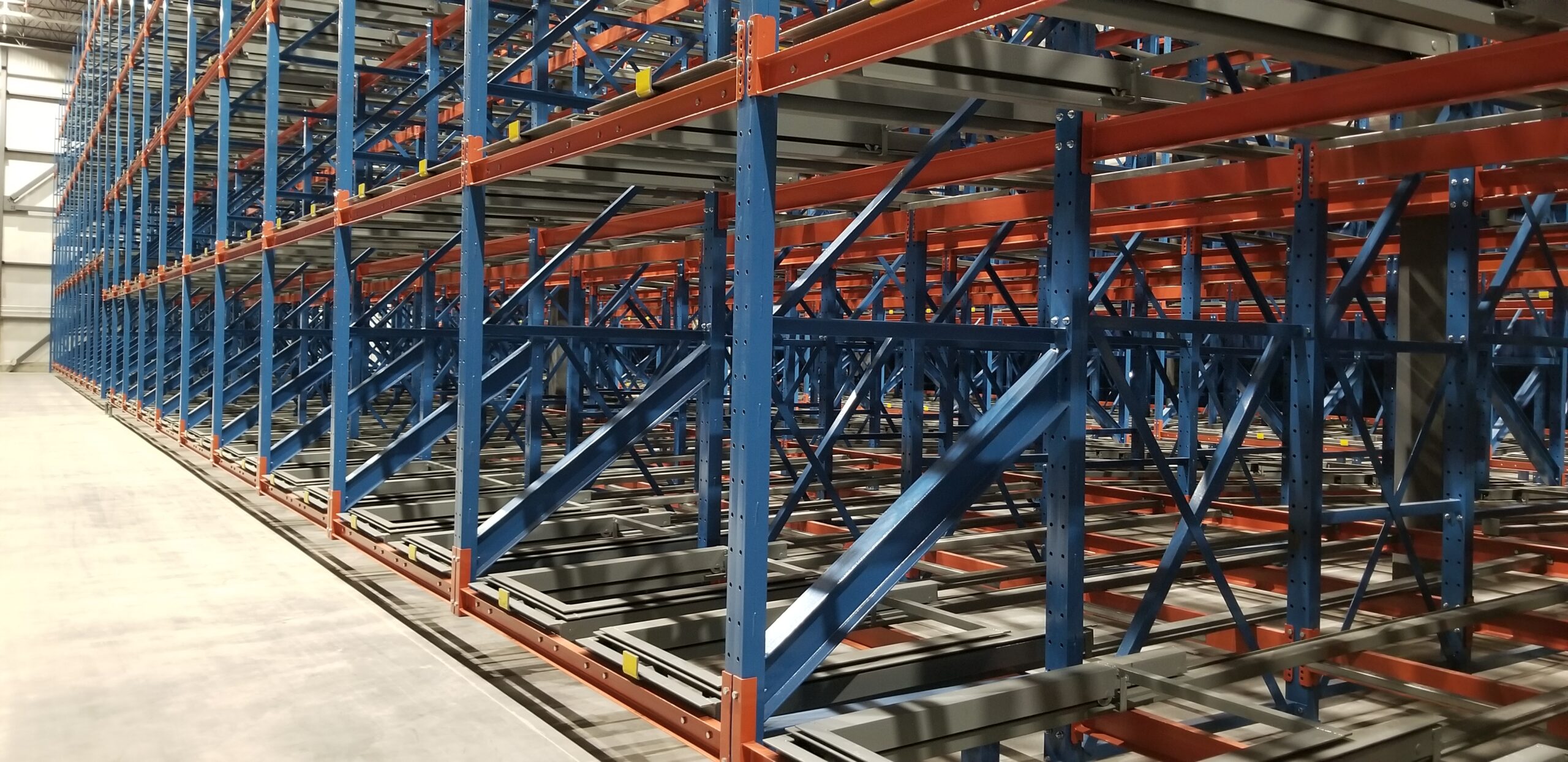
Why Pushback and Pallet Flow Are Powerful Upgrades for High-Density Storage
“Industrial pallet racking” is often used as a catch-all phrase. End users mean it as “strong, safe, and built for real warehouse work.” Dealers know it also has to mean something else: a storage system that holds up operationally when volumes rise, aisles get busy, and the building stops forgiving layout mistakes.
For growing warehouses, the most reliable path “beyond the basics” is usually not a new flavour of selective rack. It is a thoughtful mix of storage types, with dynamic systems like pushback and pallet flow doing the heavy lifting where density, throughput, and repeatable handling matter most.
When customers start asking about industrial pallet racking options, it can be helpful to have a practical way to steer those conversations toward solutions that perform in real life.
What “industrial pallet racking” should signal to a dealer
When a customer says they want industrial pallet racking, they are typically signalling one or more of these constraints:
- Space is getting tight, and expansion is not the first choice
- Forklift travel is eating labour and time
- SKU counts are rising, but there are still “deep” items that dominate volume
- Damage, safety, or inconsistent handling is becoming costly
- They need a layout that will still work after the next growth phase
That combination is where high-density dynamic systems earn their place. Not because they are “premium,” but because they are designed to keep working when a warehouse stops behaving like a simple storage room.
Growth Has an Effect on the Job the Rack Needs To Do
Early-stage warehouses often buy racking for access. Later-stage warehouses need racking for performance.
As volumes increase, a layout that once felt “fine” starts producing friction:
- Aisles get congested
- Easy-access pick positions become scarce
- Operators spend more time travelling than loading
- Selective layouts start consuming floor area that should be generating throughput
In that phase, “industrial pallet racking” becomes less about beam capacity and more about how the system manages motion: pallet handling, forklift travel, replenishment, and consistent storage density.
Selective rack: the access champion, the density limiter
Selective rack is hard to beat for broad SKU access, especially when pallet quantities per SKU are low (1–5). The tradeoff is density, since selective racking has the lowest theoretical pallet count per footprint compared to higher-density options.
Drive-in: density looks good on paper, but inventory rarely cooperates
Drive-in can be a fit in some situations. In practice, many modern operations struggle to keep drive-in occupied efficiently as SKU profiles change, demand fluctuates, and safety expectations rise.
Floor stacking: cheap storage is rarely cheap operation
Many sites revert to floor stacking under pressure, then discover the real costs in damage, lost cube, blocked access, and messy rotation.
If a customer is asking about industrial pallet racking, they are usually already feeling these limits.
A dealer’s cheat code: diagnose the inventory profile before proposing a system
A quick way to steer an industrial pallet racking conversation into the right lane is to focus on two questions:
1. How many pallets per SKU are typical, and what is the range?
2. What matters more operationally: density, throughput, or rotation?
This avoids the common trap: choosing a storage type first, then forcing the inventory to behave.
A useful way to start the conversation is to look for inventory tiers:
- Which SKUs are shallow
- Which products have steady depth
- Which high-runners should be prioritized for high-density storage
That is the opening for a hybrid layout, where selective racking supports broad SKU access, and pushback or pallet flow is applied to the products with enough depth or velocity to justify dynamic, high-density lanes.
Pushback as industrial pallet racking
Pushback is often the first “beyond basics” solution that clicks for customers, because it solves a familiar pain without over-complicating operations.
Why pushback earns its place
Density without sacrificing workable access
Lanes allow depth storage while keeping loading and unloading from the aisle.
Strong fit for the “middle band” of inventory
Products with enough depth to justify lanes, but not always the consistency required for deeper flow applications.
Operational simplicity
For many sites, pushback is a straightforward step up: higher density, fewer aisles, less travel.
Where dealers win with pushback
Pushback sells well when it is positioned as a practical answer to real warehouse constraints:
- “You do not need a bigger building to gain meaningful capacity.”
- “You can protect pick faces while adding depth where it matters.”
- “You can reduce forklift travel without adding complexity to every pick.”
Pushback boundaries to set early
Helpful selling is also about setting expectations. Pushback is not the perfect fit when:
- The customer needs strict FIFO across the full system
- They have extremely low pallets per SKU across the board
- They expect to mix many SKUs within a lane and still keep it clean
Pallet flow as industrial pallet racking
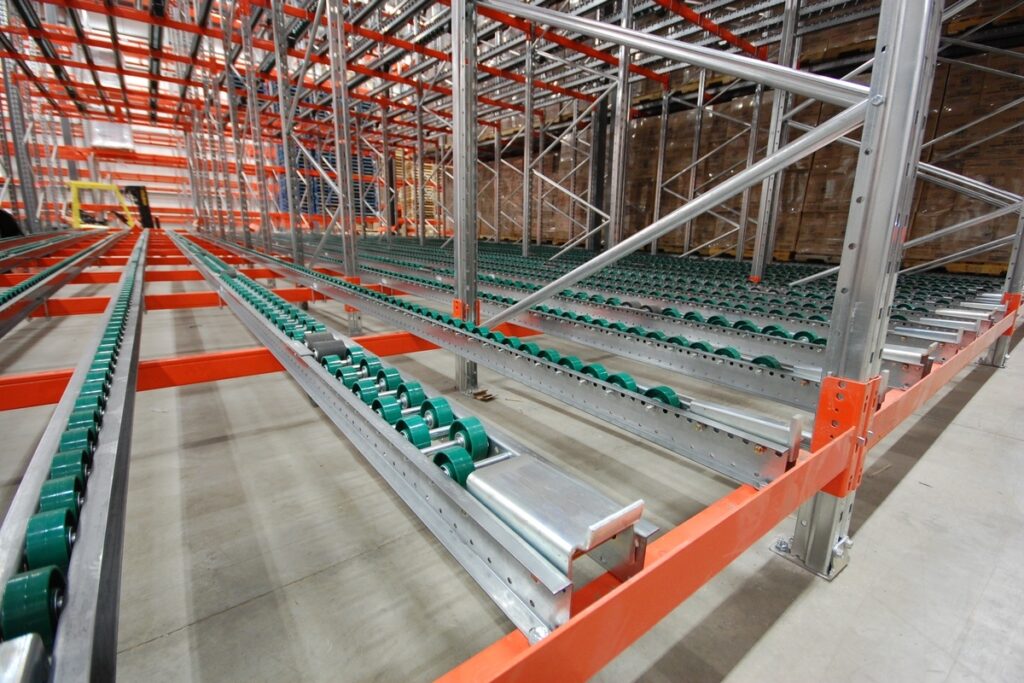
If pushback is the practical “density upgrade,” pallet flow is often the throughput accelerator.
Why pallet flow becomes the right answer
True FIFO
This matters in food, beverage, regulated goods, and many manufacturing environments.
Reduced forklift travel
Load on one side, unload on the other, with gravity doing the movement in between.
High-volume staging and replenishment
Pallet flow often shines in pick modules, manufacturing feed lanes, and shipping or production staging where consistent movement is the goal.
Pallet flow rewards the right application
Pallet flow is industrial pallet racking when it is engineered to match the reality on the floor, including:
- The pallets actually being used
- The weight range and load condition
- Expected lane depth and throughput
- Speed control and safe accumulation
Pallet flow benefits from application-specific design. When it is specified and installed to match the operation, performance is far more consistent.
Choosing between pushback and pallet flow
A simple way to position this for customers is:
- Pushback is often the better answer when the priority is good density and a strong fit for high-turnover SKUs with medium-to-high pallet depth.
- Pallet flow is often the better answer when the priority is higher throughput and automatic stock rotation (FIFO behaviour).
Both are industrial pallet racking solutions. They are simply built for different operational scenarios.
A practical comparison dealers can use
Lean towards pushback when:
- The customer has meaningful pallets per SKU but variable demand
- The customer wants high density without committing to a deeper, more engineered flow zone
- The customer wants a simpler operational transition
Lean towards pallet flow when:
- Rotation is non-negotiable
- The operation benefits from separation of load and pick aisles
- Replenishment speed and order staging matter
If the customer is undecided, it can be useful to propose a hybrid: pushback for the “steady middle,” pallet flow for the true high-volume or FIFO-critical products.
“What makes it industrial?”
Many buyers assume industrial pallet racking is defined by steel thickness or capacity. In dynamic systems, “industrial” is often defined by the performance details that prevent headaches later.
Examples that tend to matter:
- Pallet compatibility and consistency
- Lane design matched to real throughput
- Reliable speed control and accumulation behaviour
- Installation accuracy and proper setup
- Operator training aligned with the system’s handling realities
When dealers lead with these topics, they sound less like a vendor and more like a guide. That is usually what customers want when they search for industrial pallet racking options.
How 3D Storage Systems supports dealers selling industrial pallet racking
Dealers do not just need a product. They need confidence that the design will perform, the quote will be clean, and the solution will install without surprises.
That is where 3D Storage Systems supports its dealer network, with a focus on dynamic systems that solve real warehouse constraints:
- Pushback and pallet flow layouts designed around inventory profile and building realities
- Clear quoting support, including drawings and a bill of materials structured for real projects
- Application guidance that helps dealers avoid common performance pitfalls in dynamic systems
- Engineering-first collaboration when a customer has unique constraints or special handling requirements
When a customer is asking for industrial pallet racking, the dealer who can translate that request into a working pushback or pallet flow solution is the dealer who earns trust and closes projects.
Quick FAQs dealers can use in sales conversations
What counts as industrial pallet racking?
A system that stays safe, efficient, and predictable under real warehouse conditions, not just a system that meets capacity requirements.
Is pushback considered industrial pallet racking?
Yes, when it is applied to the right inventory profiles and designed for consistent daily handling.
When is pallet flow better than pushback?
When FIFO and throughput are priority requirements and the operation benefits from gravity-fed replenishment.
Can a warehouse use both pushback and pallet flow?
Often, yes. Many of the best layouts mix storage types so each product group gets the right solution.
If a customer is asking about industrial pallet racking, a strong next step is to request a quick inventory and building snapshot and have a concept layout built around pushback and pallet flow zones. That keeps the conversation practical, avoids overselling, and points the customer toward a solution that will still work as they grow.